Pre-launch working draft

Open-source digital infrastructure for the Ummah.

Zakat and waqf data standards, shared trust networks and reference code. Built in public.

What UDI is

UDI is an open community of practice where technologists, scholars, policymakers and Muslim-owned companies work in public. The Ummah has the experts, the capital and the users, but no shared place to build. We publish four kinds of output: solutions (code), plans, standards and evidence.

Why it is needed

The Muslim world is strong at the bottom of the stack and the top, and absent in the middle. It holds almost none of the design tools, fabs, chips, cloud platforms or frontier models in between.

  • Open on top, rented underneath

    Public digital systems are often open at the top. The servers, chips and cloud contracts they run on are usually proprietary and foreign.

  • Nothing shared across borders

    Digital public infrastructure in OIC countries works at national scale, but no rail is shared across OIC countries or published as a digital public good.

  • Rules locked in prose

    Zakat and waqf rules are written in prose, and national systems run them on closed software. None of it is published as an open schema, API or shared identifier.

Three numbers from our research

The stack, and who holds the key

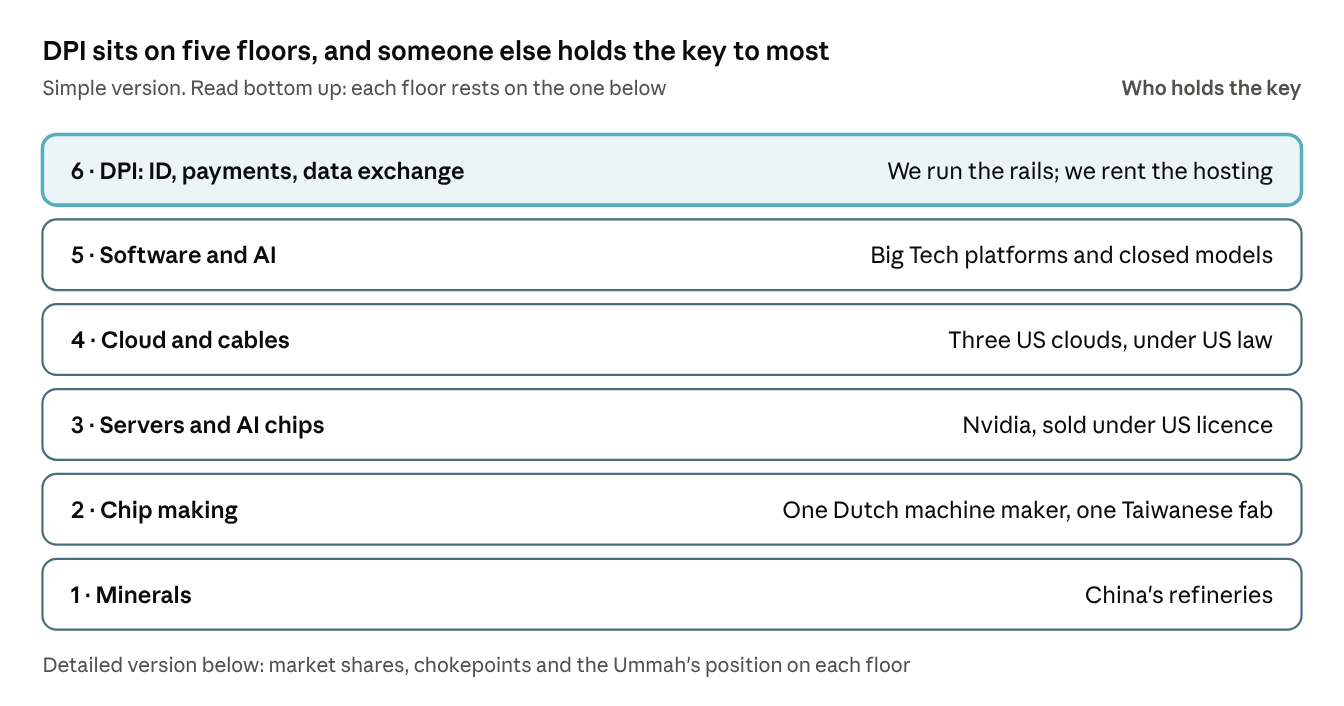
Read it bottom up, like a building. Every layer depends on the one below. Each layer has a chokepoint held by one to three firms or states.

Six floors of technology, from minerals at the bottom to digital public infrastructure at the top, with who holds the key to each.
Text version of this diagram

Title: “DPI sits on five floors, and someone else holds the key to most”. Read bottom up; each floor rests on the one below. Floor, then who holds the key:

  1. DPI: ID, payments, data exchange. We run the rails; we rent the hosting.
  2. Software and AI. Big Tech platforms and closed models.
  3. Cloud and cables. Three US clouds, under US law.
  4. Servers and AI chips. Nvidia, sold under US licence.
  5. Chip making. One Dutch machine maker, one Taiwanese fab.
  6. Minerals. China’s refineries.

Open full size (new tab)

How it could work

These are sketches for discussion, not a finished design. We start small: prove the process on zakat and waqf data before anything bigger.

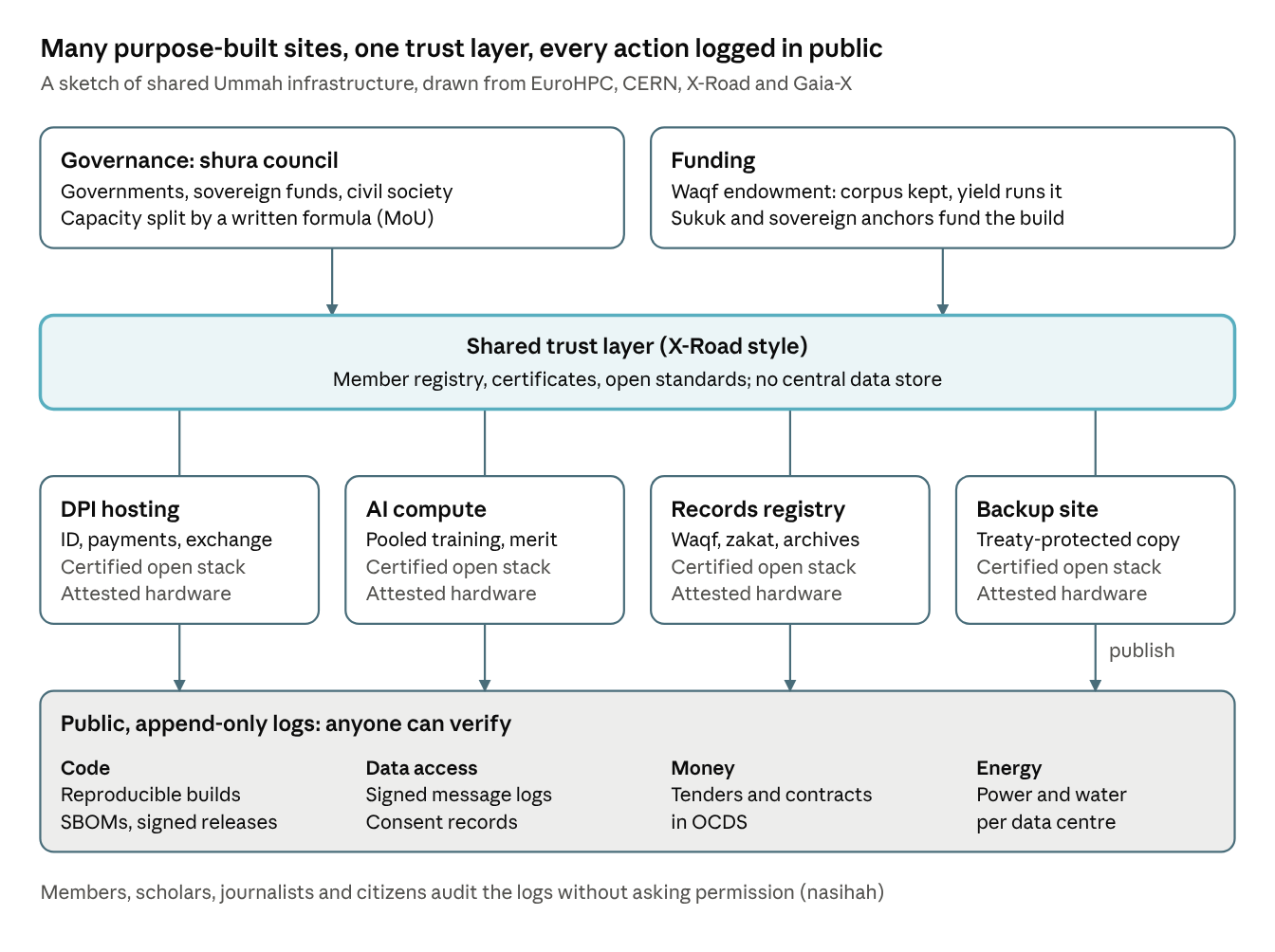
Many sites, one trust layer, every action logged in public

Governance and funding sit above one shared trust layer. Purpose-built sites hosted by different members join that layer. Every site writes its code, data access, money and energy to public logs.

Governance and funding boxes feed one shared trust layer, which connects four purpose-built sites, which all publish to public logs.
Text version of this diagram

Title: “Many purpose-built sites, one trust layer, every action logged in public”. A sketch of shared Ummah infrastructure, drawn from EuroHPC, CERN, X-Road and Gaia-X.

  1. At the top, two boxes. Governance: shura council, with governments, sovereign funds and civil society, and capacity split by a written formula (MoU). Funding: a waqf endowment (corpus kept, yield runs it), with sukuk and sovereign anchors funding the build.
  2. Both point down to the shared trust layer (X-Road style): member registry, certificates, open standards; no central data store.
  3. The trust layer connects to four purpose-built sites, each on a certified open stack with attested hardware: DPI hosting (ID, payments, exchange); AI compute (pooled training, merit); Records registry (waqf, zakat, archives); Backup site (treaty-protected copy).
  4. Each site publishes to public, append-only logs that anyone can verify: Code (reproducible builds, SBOMs, signed releases); Data access (signed message logs, consent records); Money (tenders and contracts in OCDS); Energy (power and water per data centre).
  5. Members, scholars, journalists and citizens audit the logs without asking permission (nasihah).

Open full size (new tab)

How a contribution moves

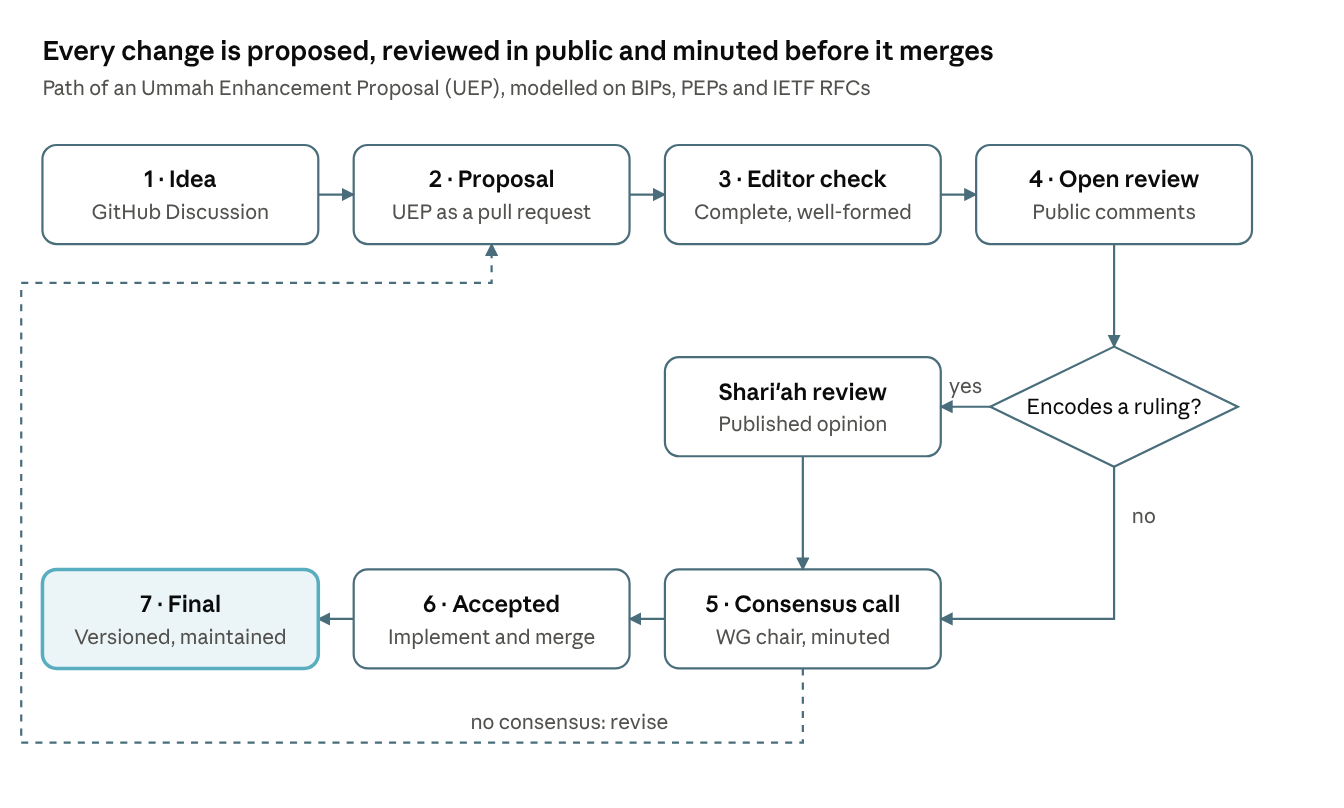
Every solution, plan or standard enters as a written proposal. It is reviewed in public, and goes to the Shari’ah panel if it encodes a ruling. It is accepted only on a minuted consensus call; without consensus it goes back for revision.

Seven steps from idea to final, with a Shari’ah review branch for proposals that encode a ruling and a revise loop when there is no consensus.
Text version of this diagram

Title: “Every change is proposed, reviewed in public and minuted before it merges”. The path of an Ummah Enhancement Proposal (UEP), modelled on BIPs, PEPs and IETF RFCs.

  1. Idea: a GitHub Discussion.
  2. Proposal: a UEP as a pull request.
  3. Editor check: complete and well-formed.
  4. Open review: public comments. Then a question: does it encode a ruling? If yes, it goes to Shari’ah review (a published opinion) and then to step 5. If no, it goes straight to step 5.
  5. Consensus call: the working-group chair, minuted. If there is no consensus, it goes back to step 2 to be revised.
  6. Accepted: implement and merge.
  7. Final: versioned, maintained.

Open full size (new tab)

The first 18 months

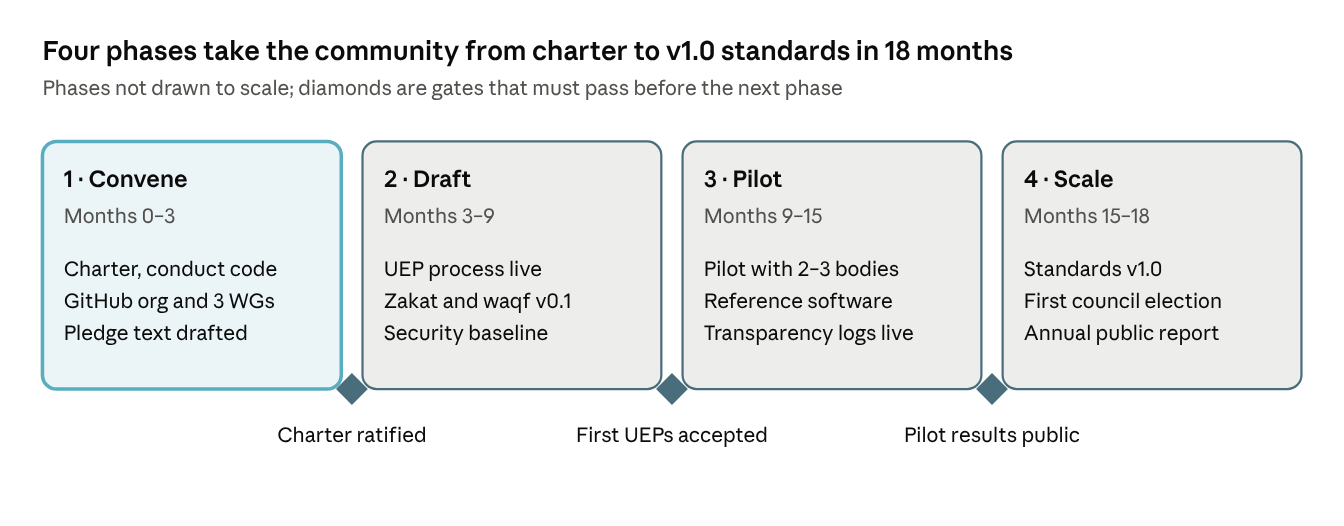
A phase opens only when the previous gate has passed in public. The durations are proposals for the founding members to adjust.

Four phases over 18 months, Convene, Draft, Pilot and Scale, with three gates between them.
Text version of this diagram

Title: “Four phases take the community from charter to v1.0 standards in 18 months”. Phases are not drawn to scale; gates must pass before the next phase.

  1. Convene, months 0–3: charter and conduct code; GitHub organisation and 3 working groups; pledge text drafted. Gate: charter ratified.
  2. Draft, months 3–9: UEP process live; zakat and waqf v0.1; security baseline. Gate: first UEPs accepted.
  3. Pilot, months 9–15: pilot with 2–3 bodies; reference software; transparency logs live. Gate: pilot results public.
  4. Scale, months 15–18: standards v1.0; first council election; annual public report.

Open full size (new tab)

Coming soon

Two parts of UDI are planned but not open yet.

Registry

Coming soon

A public list of Muslim open-source projects that meet a shared standard, scored and rechecked each year. It is modelled on the Digital Public Goods Alliance registry.

The scoring standard is not agreed yet. The first list will cover these kinds of project:

  • Zakat tools
  • Waqf tools
  • Masjid tools
  • Open standards
  • Zakat data

Members

Coming soon

Everyone gives something different; nobody buys a vote. These are the planned member types.

Individual expert
Gives: code, reviews, research, standards drafting, translation. Gets: public credit in commits and releases; a path to reviewer, maintainer and council seats.
Islamic scholar
Gives: Shari’ah review of proposals that encode rulings. Gets: published, named opinions; a seat on the review panel.
University or research centre
Gives: students, research projects, test environments. Gets: co-authorship on standards; access to real problems and data.
Civil-society organisation (zakat body, waqf, NGO)
Gives: real requirements, pilot sites, feedback. Gets: free open tools built for their needs; influence through the council’s civil-society seats.
Muslim-owned company
Gives: money, seconded engineers, infrastructure, products, under the pledge. Gets: recognition as a public-benefit sponsor; early, equal access to standards; credit under CSR reporting.
Sovereign fund or development bank
Gives: anchor capital, sukuk, waqf endowment. Gets: a council seat for funders (no technical vote); a public audit of how its money was used.
Government
Gives: policy cover, procurement, pilots in national DPI. Gets: standards it can adopt with no vendor lock-in; shared costs with other members.

Follow the work, in public

Everything UDI makes is published on GitHub. Read the research and see what is being drafted.